
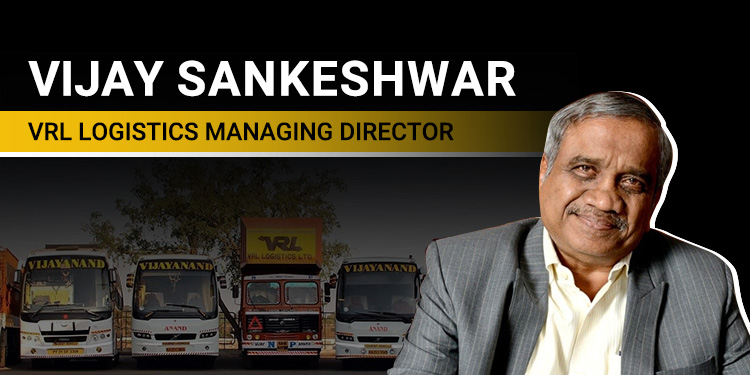
Vijay Sankeshwar, a visionary leader hailing from Dharwad, Karnataka, is the proud owner of India’s largest fleet of commercial vehicles. As the Managing Director of VRL Group, he oversees a fleet of over 5000 trucks. Sankeshwar’s keen business acumen has not only led to the establishment of successful enterprises but has also left a significant impact on society. Throughout his illustrious career, Vijay Sankeshwar has remained dedicated to values such as hard work, innovation, and compassion. **Vijay Sankeshwar: Interesting Facts** – Fondly known as the ‘Trucking King of India.’ – In 2022, his son Anand Sankeshwar announced the production of a biographical film titled “Vijayanand,” chronicling his father’s extraordinary journey. – Commenced his business journey at the age of 16. – Upgraded his printing press with modern machinery at the age of 19. **Vijay Sankeshwar: Education and Childhood** – Born on August 2, 1950, in Betagiri, a small town in Mysore, Karnataka, India. – Hails from a humble family with an agricultural background. – Despite facing childhood challenges, Sankeshwar exhibited a resilient spirit and profound entrepreneurial mindset. **Journey as an Entrepreneur** >”All of my ventures were completely and undoubtedly based on the trial and error method. We have never copied anyone in our business models, ever.” —- Vijay Sankeshwar Vijay Sankeshwar initiated his entrepreneurial journey in 1966 when his father presented him with his first printing press, Vijay Printing Press. Starting with modest equipment and two employees, he expanded the printing enterprise in 1969 with modern machinery. Simultaneously, he ventured into the transportation industry with a single truck acquired through a Rs. 2 lakh loan. Sankeshwar’s emphasis on customer satisfaction, efficiency, and reliability positioned VRL Group as one of India’s largest logistics and transport companies, boasting a vast fleet of trucks, buses, and cargo carriers. **Diversification and Expansion of VRL Group** Driven by a passion for growth and diversification, Sankeshwar expanded VRL Group into various sectors. The company now spans road transportation, parcel services, courier services, hospitality, and media Vijayavani has gained widespread popularity and played a significant role in shaping public opinion in Karnataka. **Philanthropy and Social Contributions** – Actively involved in various charitable initiatives. – Through the VRL Foundation, the CSR arm of VRL Group, contributed to educational institutions, healthcare facilities, and community development programs. **Vijay Sankeshwar: Association with Politics** – Initiated his political involvement during his early years, actively participating in meetings organized by the Rashtriya Swayamsevak Sangh (RSS). – In 1996, ventured into politics, winning the 11th Lok Sabha elections from the Dharwad constituency as a Bharatiya Janata Party (BJP) member. – From 1999 to 2000, served on various parliamentary committees, including Transport and Tourism. – In 2003, founded the Kannada Naadu Party (KNDP) after a conflict with the BJP but reconciled with the party in 2014 when the Karnataka Janata Paksha (KJP) merged with the BJP. **Vijay Sankeshwar: Awards and Achievements** – Udyog Ratna Award by the Institute of Economic Studies in 1994. – “Transport Personality of the Year” at the India Road Transportation Awards (IRTA) in 2012. – Awarded the Padma Shri in 2020, India’s fourth-highest civilian award, by President Ram Nath Kovind. Vijay Sankeshwar’s net worth stands at $8 million (as of 2022), serving as an inspiration for entrepreneurs, emphasizing that success can be achieved through hard work and a commitment to making a positive impact on society.

The evolution of GreyOrange
India’s GreyOrange, often overlooked in the realm of deep-tech innovation, has emerged as a dark horse in the $10 billion e-commerce robots industry, surpassing expectations as a global leader. Co-founders Akash Gupta and Samay Kohli, who initially met at BITS Pilani in 2007, embarked on a challenging journey to create something extraordinary. In 2011, with an investment of 5 lakhs, Gupta and Kohli established GreyOrange, defying the assumption that India was an unlikely hub for deep-tech innovation. Focused on robotics, their journey began with the creation of Acyut, India’s first humanoid, earning them gold at the World’s Robo Olympics. Despite the absence of a conducive startup or hardware ecosystem, they persisted. A turning point came in 2012 when a visit to Flipkart’s warehouse inspired them. The complex warehousing problem required an elegant solution, and with the support of German technologist Wolfgang Hoeltgen, who moved to India to mentor them, GreyOrange secured its first order from Flipkart. The development of the Butler Robot system revolutionized warehouse operations, with Flipkart reporting a 4x increase in item picking and an 80% drop in shipment time. GreyOrange’s potential became evident, leading to a significant fundraising round. By 2016, challenges like one-day deliveries and labor shortages became prominent, mirroring global trends seen in Amazon’s acquisition of Kiva. India’s GST ruling further propelled GreyOrange’s growth as it moved towards central warehousing. The company’s trajectory continued to impress, with Home Logistics in Japan selecting GreyOrange in 2017, and a staggering 300% growth by 2018. The company raised an impressive $140 million, reaching $100 million in revenue by 2019, a noteworthy achievement for a deep-tech Indian company. The COVID-19 pandemic in 2020 transformed robots from a luxury to a necessity, propelling e-commerce and diminishing labor availability. GreyOrange responded swiftly, raising $110 million in 2022, valuing the company at $600 million. Despite a challenging year that delayed IPO plans and prompted a management reorganization, GreyOrange started 2023 strongly with $150 million in revenue. The company has solidified its position as a global leader in mobile autonomous robots, expanding its team to 1,000 people worldwide and hiring regional CEOs. GreyOrange’s journey exemplifies how a robotic ambition from India can evolve into a globally recognized company over a decade.