
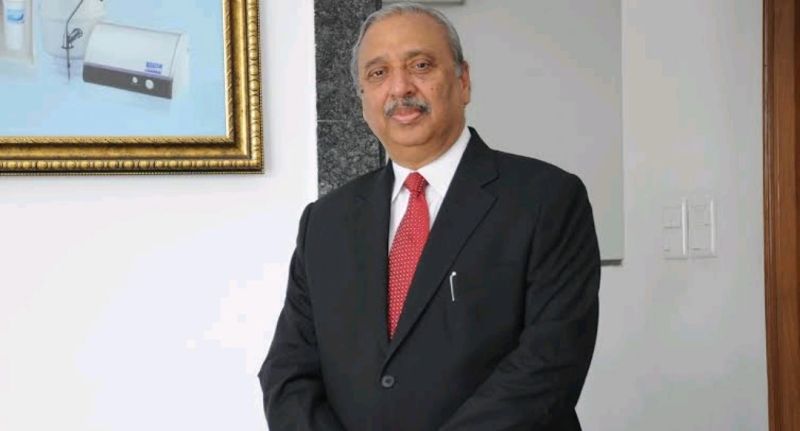
Dr. Mahesh Gupta’s children developed jaundice after consuming contaminated water, a problem that affected 200,000 people in India. The absence of effective water purifiers in the market prompted Mahesh to take action.Using the 20,000 rupees he had saved from his job at Indian Oil, Mahesh imported a membrane and pump from the US to create his home purifier. However, developing the purifier proved challenging, as he experimented with various technologies for six months without successfully removing impurities from water.After half a year of exploration, Mahesh discovered the Reverse Osmosis (RO) technology for purifying water, marking an unprecedented innovation in the unorganized Water Industry. In 1999, Kent water purifier was established.The market posed challenges, with Eureka Forbes holding a dominant 70% market share through Aquaguard. Mahesh introduced his product at Rs 20,000, competing with Aquaguard priced at Rs 5,000, relying on the belief in superior technology to drive sales. However, the strategy initially did not yield the expected results.In its first year, Kent RO only sold 100 systems. Despite this, the brand had a strong recall value. Mahesh decided to adopt a door-to-door sales approach, and the strategy gained momentum, with Kent selling 20 units per month. Despite limited funds for advertising, with only Rs 5 lakh in capital, Mahesh focused on word of mouth and distribution.Kent RO found success by placing products in kitchenware specialty retail outlets, where customers could witness the purity of water firsthand. By 2005, sales reached 30 CR.Recognizing the need for branding, Mahesh sought a women’s brand ambassador. In 2006, the legendary Hema Malini became the face of Kent RO with the iconic tagline “Kent RO hi lena.”The advertising campaign transformed Kent RO. By 2010, the company achieved a revenue of 250 CR, growing annually by 45%. Production expanded to a massive facility in Roorkee, Uttarakhand, capable of manufacturing 1 million units annually.With increased capacity and a successful advertisement, Kent RO sold 5 lakh units in 2015. By 2016, revenue reached 830 CR, followed by 950 CR in 2017. The company boasted over 600 distributors, 150 franchise outlets, and 1000 retailers.In 2020, Kent RO achieved a revenue of 1200 CR, securing an impressive 30% market share. Aquaguard’s market share decreased from 70% to 40%. Attempts by HUL and TATA to replicate Kent RO’s technology fell short. Today, Kent water purifier employs 3000 individuals, holding an extraordinary 45% market share. The company has expanded its presence to Nepal, Bangladesh, Kenya, and the Middle East. Among Dr. Mahesh Gupta’s numerous awards, the title “Pure Water Man of India” remains his most cherished.
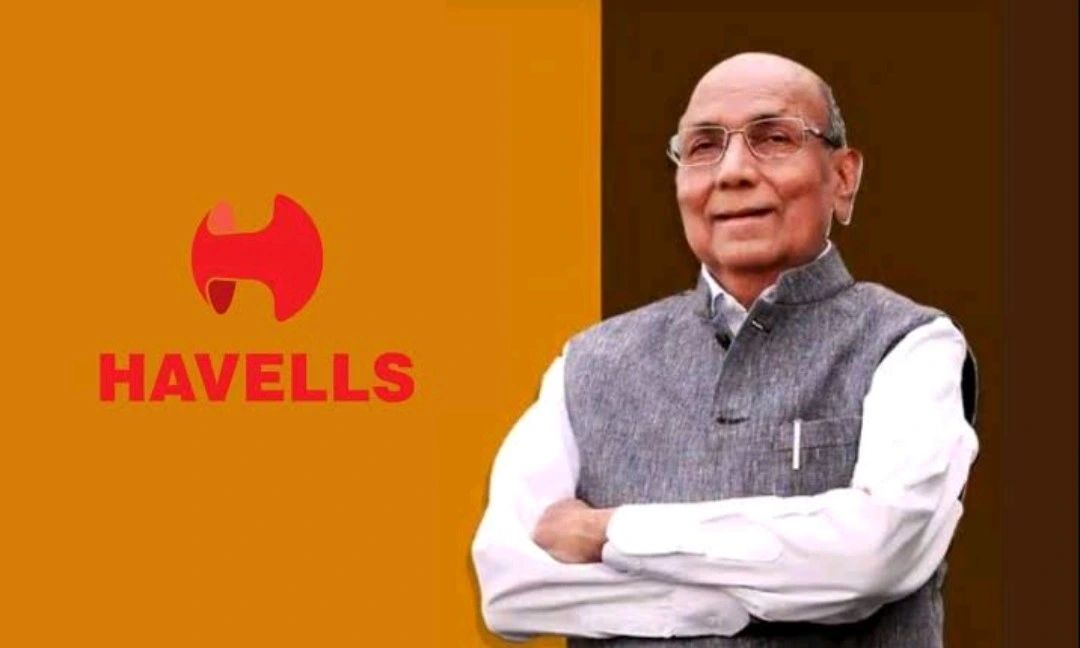
Qimat Rai Gupta and the story of Havells Electricals
In 1958, armed with Rs 10,000, a school teacher migrated from Punjab with a vision to establish an electrical trading shop in Delhi’s wholesale market, Bhagirath Palace. Despite the market already hosting numerous distributors, the teacher, Qimat Rai Gupta, founded GuptaJi & Company in 1958.The concept was straightforward: trading fixtures and electric cables. Qimat navigated the decade by dealing in cables, wires, and switchgear for various brands. However, his major breakthrough occurred in 1971.Qimat distributed industrial switchgear for a brand named “Havells,” named after Haveli Ram Gandhi. Despite possessing a strong brand, Havells struggled with product sales. Seizing the opportunity, Qimat purchased the brand for a mere Rs 7 Lakh in 1971, rebranding GuptaJi & Co as Havells.Recognizing the inefficiency of selling directly to retailers, which impacted margins and quality, Qimat initiated in-house manufacturing. In 1976, Havells established its first switches factory in Delhi’s Kirti Nagar.Realizing the need for dedicated factories for each appliance to maintain quality, Qimat opened one for HBC fuses in 1979 and another for energy meters in 1980. The challenge arose when Chinese products flooded the market.Despite lacking quality, Chinese products were unbeatably cheap. Qimat responded by acquiring the struggling “Towers and Transformers” in 1983, fortifying production to withstand the Chinese competition.Qimat swiftly transformed “Towers and Transformers.” By 1992, Havells Electricals had grown into a 25 CR company, going public and trading on the stock exchange in the same year.Maintaining pace with manufacturing demands, Qimat acquired companies between 1997 and 2001, including ECS, Duke Arnics Electronics, Standard Electricals, and Crabtree India. The company reached a milestone of 1000 CR, relocating to a sprawling 130,000 sq ft office in Noida. Challenges arose when prominent foreign players entered the arena.To counter GE, Philips, Crompton Greaves, and Osram, Qimat recognized the necessity of acquiring a major player. In 2007, Havells acquired the fourth-largest player, Sylvania, for 2000 CR, marking the FMEG industry’s most significant acquisition.Post-acquisition, Havells expanded to a size of 7000 CR. Introducing products in the domestic segment like ACs, Fridges, and other appliances, Qimat quadrupled the marketing budget to 60 CR and introduced the iconic “Shock Laga” ads. By 2019, Havells had evolved into a 10,000 CR company. Today, Havells stands as a 14,000 CR company with over 20,000 distributors, 6500+ employees, and 16 factories globally, a testament to Qimat Rai’s invaluable and electrifying legacy.