
Best Accountant WordPress, Owning an accounting website will boost the visibility of your accounting sector or independent services, with the benefits of attractingWizard’sWizard’s clients. Having a website for your own company is a matter of pride but learning a designing skill for making a website takes time. No worries!! Making a website has become much easier, all thanks to Word press thems. The correct accountant theme will help you to establish credentials and Help to get clients to your word press websites. What are we waiting for, lets explore some of the best options below. Best Accountant WordPress Themes The collection of the best themes for accountants and professionals in a variety of forms for financial fields is illustrated below. every theme mentioned below has a unique appearance and is covered with features that will make your website look professional with WordPress. Time to check them below. Best Accountant WordPress Theme #1 – Avada Avada is not just a theme but more than that — it is an all-rounder website builder that has a default of 80 pre-built websites. One of those websites is Avada Accountant. The super-smooth and classy themes are perfect for any accounting, tax, shopkeeping, or other financial targets. It is designed with pages which is ready to highlight the services, industries, resources, news, etc…that you are going to offer. Additionally, very easy to customize cheers to Avada’s drag-and-drop builder which comes with 115+ design elements. Key Features Default features for accountant website plus website builder 115+ design elements 2. Best Accountant WordPress Theme #2 – Wizor’s It is a Stylish and very professional theme for this type of firm and other businesses related to finance. This theme offers you premade pages for every single part of the site, such as the homepage, Services, Products, Team, and Contact pages. Additionally comes with the benefits of the WPBakery Page Builder and its powerful theme framework which includes 750 customization options that make it so easy to customize your website design. This is also considered as one of the best accountant WordPress themes Key Features Default made home, services, products about, team, and contact pages WPBakery Page Builder plugin included Powerful theme framework which has 750+ customization options Best Accountant WordPress Theme #3 – Accounting As the name sounds, Accounting is a multi-structure theme designed especially for a profession like Accounting. It Includes 10 default demos which is ready to be used and can easily be customized using the WPBakery Page Builder plugin which will match your unique needs and business. It Includes certain custom theme options panels for processing your theme style, layout, logo, CSS, and much more. Key Features WPBakery Page Builder plugin included 10 default designed demos Super cool custom theme options panel Best Accountant WordPress Theme #4 – Amwal Amwal is a rich-feature theme designed for consultants, finance experts, and accounting agencies. It helps you to create a different site in very little time, It comes with 10 homepage super easy demos, 8 header layouts, 6-footer layouts, and 3 Service page layouts — all get mixed and match. It’s easy to customize the entire theme using the feature of drag-and-drop and WPBakery Page Builder. Key Features WPBakery Page Builder plugin included 10 homepage demos 14 header and footer layouts 5. Finance Planned exclusively for accounting, financial, brokerage, consulting, and other business websites, The Finance is a super multiple-column fully multi-column responsive that comes packed with features for creating an interactive website. This is one of the best accounting WordPress themes. It also includes 12 demos with a comprehensive options panel, It provides unique page transitions, distinctive typography, and a customizable quote calculator. It is the combination pack is the Visualizer plugin so you can add Google charts to your site. Key Features Integrity features which include transition effects & a quote calculator 12 demos Bundled with the Visualizer plugin so you can embed Google C 6. Consulting It is one of the best business consulting for Word Press themes which works perfectly for creating an accounting site. It has 50 demos in generals, which can be customized using the Elementor page builder plugin. It comes combined packed with three plugins — the Slider Revolution, Cost Calculator, and eRoom plugins — By all this you can create carousels, price estimation forms, and Zoom meetings and webinars directly from your website at your comfort. Key Features 50 demos Design and finalize for Elementor and Visual Composer Tie-up with the Slider Revolution, Cost Calculator, and eRoom plugins 7. Auditing It is generally created for brokers and accountants, It is a fully responsive theme which has unique features and designs. For eg: it has a multiple-column layout which gives you an advantage to have anywhere from one to six columns on your pages. new feature which keep Auditing apart from the other accountant themes built-in with Kirki customizer. This Plugin gets your control over the background, color palette, typography, and remaining parts of the theme. The drag-and-drop Visual Composer is added with this theme for more access where you build and customize your site. Key Features Multiple column layouts Kirki Customizer Framework plugin included Visual Composer included 8. Finance Perfect match for accounting and financial consulting businesses, Finance has highly equipped tools and best customizable theme. It contains six demos, each of which can be used as one page or multi-page theme. constructed using the Redux frame, the theme is easily customized and optimized based on speed. Additionally,it has the Visual Composer plugin where you can quickly build your site and drag-and-drop functionality. Key Features 6 demos have one-page and multi-page versions Built on Redux framework Visual Composer included 9. Finance Accounting From the name you could have got the idea that It is a theme designed for accounting and other financial professionals. The simple and classy design is perfect for your services, team, and clients. According to Bootstrap, this theme is well-coded and highly customizable. It comes with a free version for those who are on a budget, and a premium version for those who need more
The Ultimate Guide To DataBase Marketing.
Database marketing is one of the important marketing techniques required by every business. Every business needs advertisements to promote its product. The advertisement is one of the keys to reaching a huge crowd in very little time. your service and product get noticed in front of potential customers and they order in large numbers to increase your sales. Most businesses have confidence in social media and its power to reach the Audience. Social media is a huge platform for getting connected with people, even though there are many advantages, we have certain disadvantages and namely two are, After having ten thousand or million followers in your profile but the Instagram algorithms which increases our followers but the reach of the post is in a very small percentage of those followers according to the post. The second point: just imagine in case the platform goes away from the market!! think about those contacts which you have got after so much struggle will go into vain. It will take only a few seconds where your thousand contacts will disappear. instantly, discovering the problem leads half of your battle to victory. After the above discussion, we could have got an idea that getting contacts is more useful than promoting in social media. The whole process is called Database Marketing. The idea behind Database marketing? The era of the digital world is equal to an ocean that has a vast ending. To run a business there is certain information which is required for building the customer Strength such as collecting names and addresses and phone number by ending the traditional method like direct mail by sending postcards, discount coupons and update copies on new product launches, etc. for your potential / old customers. If you are having a thought about traditional direct marketing regarding its efficiency, I would say it is an asset to many businesses. The digital world gives your business a world of choice for reaching the audience but It allows you to measure how the customers will be marketed and give them what they want. The below-given details where data is collected for improvising customer details such as : Names Addresses Phone numbers Buying Details This information will be created for improving personal experiences for customers. The Benefits of Database Marketing As we have got an idea regarding database marketing, Now give a thought if it’s right for you. Never mind the size of your business, The fresh database will give you insight into customer likes and future references. 1. “Keep” your contacts. Information is the biggest wealth and powerful weapon in today’s world., and when these powers are in the hands of social media platforms, your future is in danger. Social media is a very good platform, it is a good choice of marketing but depending fully on it is not a good choice. 2. Conversing with your audience members directly. When we have a direct conversation regarding the product with our potential Customers we tend to talk with them by making the right environment. Sometimes when we are contacting through social media and messages the consumers read those kinds of stuff according to their mood. It may be a spoiler Alert sometimes. 3. Divide your consumers. Creating segment “audiences” found on their population Tally, response, and Purchase history. This will give a better understanding and will help you to project better offers and the method to Attract customers. 4. Plan Trustworthy schedules that motivate them to repeat their purchases. Check out and plan Accordingly for the right time for your Consumers so that you can gain their confidence and trust for the future. 5. High josh !! for customer service. Your staff are your biggest asset and can make your company build longer. Allow them to see the conversation the customer had with your brand and company while purchasing. For every secret magic, there is only one source (i.e..Database Marketing ). Trust me it’s gonna make your business accelerate with super-duper fun and Thrill. Mistakes should be avoided during Database Marketing. There are a few challenges that can be encountered with database marketing. 1. Decomposition of Data. As we all know Information is wealth but when that wealth is not polished it starts decaying, in other sense when we don’t update the information it leads to loss of wealth as People move to another location their address changes, jobs change, inactive email addresses. we must keep updating the information. 2. Accuracy in data Erratum occurs. It happens accidentally Sometimes, and sometimes purposefully. Few customers get brainstorming that you’ll be sending them marketing emails as soon as you provide them an email address, which they Avoid hearing from you. Well, that’s Cool. If they don’t want those subscribe emails from you, please don’t reach them as they are not your ideal audience. Sending them emails without their willingness will create a bad impact and will lead to negative publicity. 3. Usage of Customer Data with proper care and effectively. Let’s imagine you receive a message from your friend after 2 years, you will get a shock. In the same way, if you send an email to your clients after 2 years or after a long gap it will create a shocking environment for the business world. Sending emails in an inappropriate duration will lead to a different scenario. It is important to write emails frequently starting with a greeting message and followed by regular messages about the products and offers. Building a Database Marketing with proper Strategy Always a proper plan will lead to a better strategy which will help the company to reach Objective and for future growth and success. 1. Finding out the Reach Every product has its customer and bar .when you say beauty products your targeted audience are both ladies and men from age 15 and above and when it is an education app, your targeted audience would be children and their parents. Keeping Targeting Audience will give you a path to take your product to the world of market. Generate an ideal customer profile and use
The Simplest Answer to, “What Is Product Marketing?”
What is Product Marketing? We would have thousands of ideas and explanations when we would have heard about product marketing. There would be thousands of answers in google but not accurate answers as every ideology or specialist have its definition. you would be amazed to hear that this part of marketing is very important as it is the among the initial step. Even though product marketing is a crucial department in the business to customer type companies. Product marketing is the procedure of Driving a product to market. This Comprimes of deciding the product’s placing and messaging, launching the product, and securing salesperson and consumers understand it. Product marketing’s main goal is to place the demand and consumption of the product. What is product marketing? Product marketing has many other roles such as once the product has arrived in the market. The procedure of marketing a product which the final step is to acknowledge the right people know about the product. The people who are aware of how to use it, based on their needs and responses of consumers are being acknowledged throughout the product’s lifecycle. Let’s discuss the various ways to start product marketing and other aspects of business that can support the product once it keeps on growing. An awesome way to brainstorm your campaign is by executing Inbound marketing methodology in your planned process. As We have mentioned earlier product marketing is a consistent approach, and your approach should be the same. Inbound marketing is a pre-planned work that focuses on grabbing your audience’s mind and changing them into your loyal customers that Speak for your product. This can be illustrated with the “Attract, Engage, Delight” model below. You can attract, engage, and delight your consumers with other chances of the business including mapping that identifies your aimed audience, providing them a clear place or marketing message, and n -number of other ideas. In short, Initiating a product plan for marketing with a way of understanding an inbound methodology which would set your business for success. Now that we have a sturdy foundation to build upon, and we are sure that you have found your answer. What does Marketing Process was seen earlier, during, and once a product is launched? Product Marketing Begin With Your Consumer A Super cool product is all about getting the attention of the people who would benefit from it. So, identify your audience for your product? where are you reaching with them, and how is your storytelling will present this product to them? While preparing to launch a product, work with the rest of your marketing team to find your organic customer and generate the message which is critical. 7 important Steps of Product Marketing The product marketers exactly know where their product should be advertised, and where to begin the marketing. Below is listed seven things that product marketers do earlier, during, and after the product enters the market: 1. Research of Product: A useful and proper planned product isn’t designed in an Air, and it is not easy to market any product easily. During the weeks and months before a product launch, product marketers work with product developers to run the product both internally and externally through monitored beta environments and its manageable condition. 2. Story of the product: Products can also be brought to the market in form of a story. What is solution will the product give? Who is facing this kind of problem? How can it solve this problem? What different it does from competitors? 3. Product-Focused Content: Product marketing is the next stop at the desks of the content creators. Here, product marketers can create various A/B tests for marketing copy, blog content, case studies, and landing pages on their respective websites — everything is dedicated to describing this product. 4. Product Launch Plan: product marketing team is not complete without a written launch plan, checking out every last and first stage of the marketing process and monitoring every responsibility at each point. 5. Product Launch Meeting: Once the product is launched, all are involved to meet the day when it’s rolled out. Similar to a rocket launch, the product marketer’s finest hour starts — and its climax is a product marketing campaign 6. Community Engagement: every product marketing creates more buzz around the product throughout the industry, The common for every marketing team is to monetize on what the market is looking at them.where reaching out to partners, influencers, and existing customers for feedback. 7. Sales Enablement: Every product is being prepared for the specific marketplace, where the sales team would be waiting with innovative ideas to develop a sales strategy around every single business opportunity. The product marketing team’s job is to meet the sales staff prior, during, and after the product is rolled between the public. This also ensures the communication created for this product by being consistent from the very first sales call. Keeping all this in mind, you may come across a few questions such as what exactly a product marketer has to do during the completion of a project. Let’s get into it. Product Marketer Job Description A Product Marketer or Product Marketing Manager promotes the products and their Specification for a target audience of organizations. Their role includes research on the company’s products, picturizing key features to Pull more customers, and Generating marketing campaigns for their products. Product Marketer Responsibilities A product marketer’s main duty is to advertise a product’s value to the aimed audience. This goal can be achieved by a combination of strategy and focus such as: Resolving the mix marketing content for generating and distributing it. Generating and managing budgets for marketing campaigns. Work with content creators to generate content that reflects the product and brand image. Manage a proper calendar of content by creating the schedule. Now, that we have come to the conclusion part. we hope you guys have a better understanding of product marketing Hence we have come to the conclusion where we have seen how product marketers work and their presence changes the product scenario and decides
7 ways to integrate Search Engine and Email Marketing
Integrate search engine and email marketing in simple ways. Marketing is the biggest strategy that every company plans for their growth but it differs from company to company. we can do our marketing in two ways as Inbound and Outbound marketing. in the case of inbound marketing, it provides merging strategies and makes marketers have incredible attachment. moreover, merging has been a challenge for marketers because of inappropriate collaboration. When it comes to these powerful tools and couple such as search engine optimization, and Email marketing. SEO is a Powerful source tool that generates traffic and leads you to searched sites. In email marketing, many companies use primary inbound to generate and send to various channels. Both the strategies are awesome in their own way. 7 Ways To integrate Search Engine and Email Marketing 1. Dispense Connection Building Content Via Email – Obviously, email is all about lead generation. There is no point in sending an email when you don’t want to generate an email, but at the same time, you shouldn’t be focused only on generating leads. Getting traffic through determines the quality of your website. For most companies, email marketing is their largest channel for marketing reach. Generating lead generation through email is a great idea, but when you create content like infographics or awesome blog posts occasionally via email, can improve the reach and, subsequently, increase the inbound links and authority of the pages, which automatically increases the domain authority and page authority of the website. In the future, you can also replace the content on that page which has an awesome lead generation, and take the benefits of all the traffic, the page is getting generated through the search engine. 2. Optimize for the Best Lead Generation Topics – Take a look at your email data. Take all the insights from the data, and find out which content has got the maximum open rates? If you are practicing email marketing for a while, then you might definitely have wonderful historical data related to your lead generation efforts. You can use this data to help you prioritize your search engine optimization efforts. After this, you can optimize for the top-performing keywords and offers from your email campaigns. 3. Test Offer Conversion Before an Email Send – it is not necessary for you to email an offer to your list the second it’s completed. Instead, you can just use traffic from search engines, pay-per-click (PPC) advertising, and your blog to take a look at the conversion rate of the landing page and the offer. You can use this data to make tweaks and improvements to the content or its landing page before sending it out to your entire list. 4. Using PayPal Click to Boost Email Click-Through Rate (CTR) – This competitive world expects more and usage of inbound marketing becomes less efficient sometimes. your expectation regarding the product needs an exposer to your ideas several times in place of converting it prior. While planning for your next huge email send that for generating lead, plan for a PPC before execution then starts the day earlier and end it a few days after the email has been sent to provide additional help support for the current email and for its bonanza. The attraction gained through these PPC ads will help you to increase the click-across rates for all your emails. 5. Search Engine Optimize Landing Pages – Never hide or disclose your landing pages. The Landing pages are very important and crucial to your inbound marketing victory. Keep in mind, before sending them out in marketing emails, you have to find time to optimize the content of your landing pages for search engines. This exactly means outstanding page titles, an awesome URL design, and similarly optimized keywords on the following page. 6. Focus on Email Sharing for Link Building – The Process of structure Connection for search engine optimization is getting your content more popularised in front many people as possible and it is also helping you to connect with those people where your business has no name. Simply sending out content to build links will not help you much enough. since. Including a quick message which will encourage people out there to forward the email to their relatives and friends. 7. Using PPC for experimenting Email Subject Lines – The Subject lines are the bigger part of an email which leads to the success of the marketing strategy. By giving simple and random guesses in the subject line will make you think about working best out of it, using Pay Per Click will help you to collect data on these subject line options. Generate five subject lines and start it for the initialization. try and initiate every time for a different PPC ad for every single subject line. Once you’ve gathered enough data and while determining which subject line had the highest click-through rate, and to know which email has been used while sending. Hence we have to conclude that how much ever big your newsletter base does not matter and how many keywords are included in the emails of the search engine can’t measure exact reach. So why don’t we take the advantage of integrating the newsletter and Search engine by using the PPC tool it will be more effective and will lead to huge market success. The Integration between SEO and email marketing is based on conveying the content from emails to the website, and conversely. The traffic to your site will start increasing rapidly, and you will start getting more organic users as they will click, reply and share the page with peers. And slowly you will start witnessing that the base of the subscribers will grow and they will notice interesting content on your blog and they will subscribe to your newsletter. I hope these 7 tips will help you to create an outstanding business strategy that will help you to grow more business by combining important factors which will help you to reach an unnamed customer. integrate Search engine and Email marketing and make your business reach new heights.
The Beginner’s guide to advanced Custom Fields in WordPress
Every millisecond more than 50 million people ping google or search engine to check their choice or desire they wanted. Developing a website for a company is a billion-dollar choice as people often get items after checking their rating and product validity in the market. The wordpress is a blogging tool and content management system which will help you to make your website more authentic and reliable for customers in terms of functionality and looks as you want. The open-source management tools offer you so much in terms of making your website a unique and updated one. you have come to this page to increase your skill in developing your company website, there is a very big responsibility on your shoulders and I am sure after reading this page and getting the insight you will get a certain new idea. From using themes, your own code, and plugins it has a lot to offer you., The WordPress site will be anything: a content hub; a marketplace; a community. If your skills permit the right combination of tools and knowledge you can be at the top of creating things. By crossing 1 million websites, Advanced Custom Fields (ACF) has become one of the most reliable tools for this trade. Another interesting fact is that many professionals are not yet handy with ACF tools and usage. DESIGN YOUR OWN CONTENT BASED ON YOUR NEEDS. Advanced Custom Fields will help you to make your complicated content in a simple and logical way. You could be amazed that what kind of tool is this which will surprise with its activity. Normally, every WordPress edit screen is limited at certain extent. It’s probably best used for a simple blog post with a title, thumbnail and content. The visual editor WordPress performs an excellent job by permitting variety content editing, well the crazy thing is that web developer feels under confident with this editing tool as it does not handle complicated things. ACF gives you an opportunity to take full control on the editor screen as it will allow you cut, trim or modify at any extent. By Using ACF, we can add fields n number of times to the WordPress visual editor. Otherwise, we can choose to hide it completely. additionally, you will get a wide array of field types which includes text, media, choice, layout etc. every field can be edited, added the way we like. A practical example: For example, you have a website where a man is sitting on a chair and very keenly doing his work in laptop. his expression shows he is happy and cheerful and his environment (i.e., living room with a bookshelf backside and couch aside). In this case, if our client doesn’t like the image or background. let us set some goals before we may come to the following conclusion: Computing our client to swap the image of “hero” by giving enabling option, so that he can change the pic as he wish. Permit the text layered of top the image to be editable. Neglect those stuffs which break these formats Let’s move ahead as we have set a goal which will help us to look further with more varieties of tools in it. WordPress Visual Editor The basic way to add content in WordPress in this another way, yet, you have to make yourself more compatible and pressurise to make it work. The image in the box of hero or the text can be changed by editor but we need to change some CSS case styles in the frontend tools to make that work. We have some issues if we use CSS classes at frontend, let’s see some issues at starting The visual editor is highly sensitive while using CSS classes. For instance, if our company client hits backspace continuously or more than few times, the chances of getting entire code deleted will become an issue. The result will totally be broken into different layouts. If a new user enters this project or this file later ,he may feel difficult in understanding the scenario and he may take lot of time in understanding the concept which may lead to waste of lot of time and energy We can conclude the above explanations that client may get many things at starting while using editor tools .he may leave a big room for so many mistakes until he is aware of all those steps he follows while editing a picture for his website or anything. Approach for ACF. By using this field, we can create our field in which our client can edit anything he wants, for example a picture of hero can edited by the way our client requires as custom fields will help you in doing so. You can see your new edited screen which will : Contributes simple and numeral editing areas for a singular content element. Adjusting of the file size its type and dimensions varies and the image uploaded is to neglect mistakes of client. Modify our theme templates in HTML to the place in which our image and text exactly the way they want. Hence, we can place that our carefully designed layout stays and also gets impacted by providing our client the freedom to make changes and modify based on their needs. Additionally, we can also go through those created intuitive UI insight of the WordPress in which our client can have a look. Alternatively, having everything inside of a single WYSIWYG editor, every editable piece of content can be separated out into its unique field. Every field has its own label and you can also add instructions. This simplifies the process and leaves no doubt in our client’s mind as to how things work. Hence these basic tips will give you some insights about the advance custom fields features and most importantly the dos and don’ts are clearly mentioned above. There is lot of other insights too for which watch YouTube videos for clear illustration. Keep your world shining with efforts and hope.
Digital marketing – SEO, Social Media and Content marketing
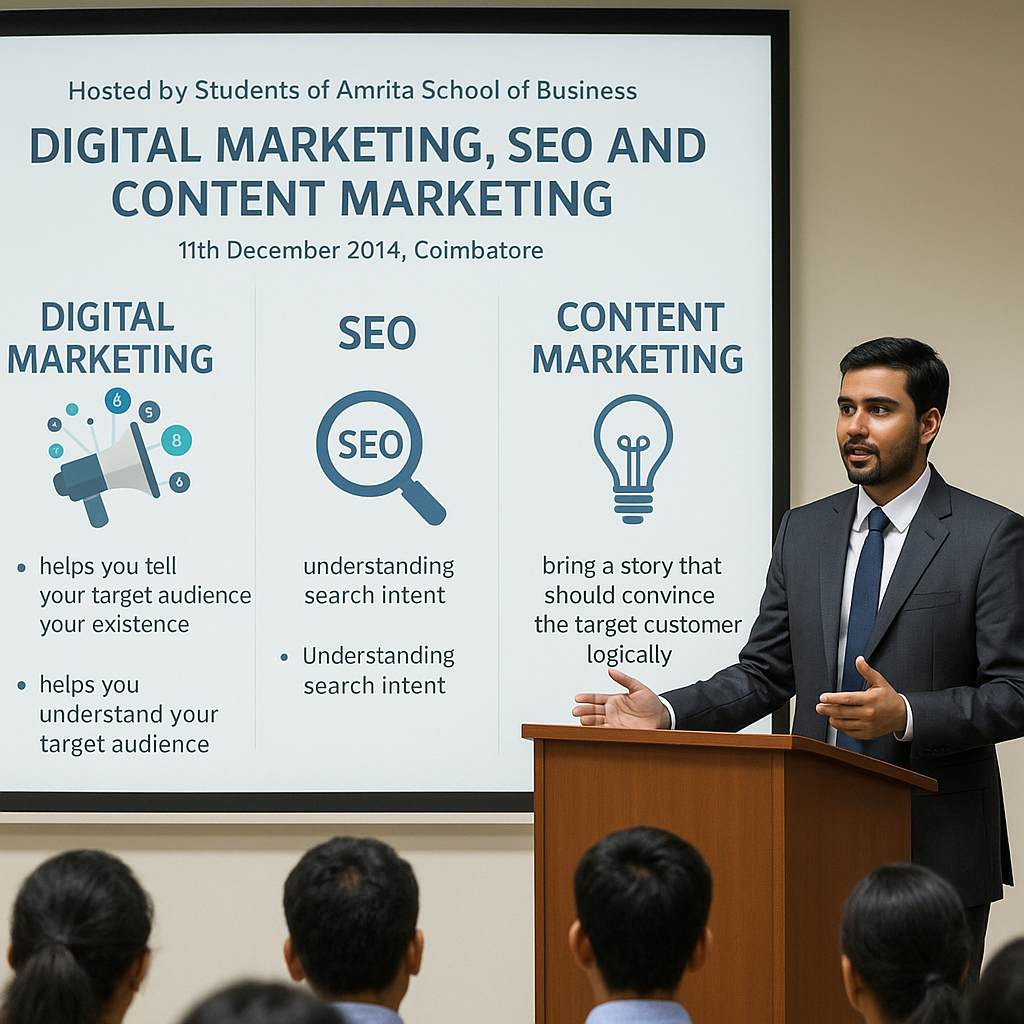
The Talk was hosted by students of Amrita School of Business on 11th December 2014, Coimbatore. The core focus of the talk was the strategic execution of Digital Marketing, SEO and Content marketing Digital Marketing: Digital marketing helps you tell your target audience your existence. In the past, when the Internet was not as popular as these days, people were restricted by the source of information they can have access to. Most of them got information from newspapers, magazines, or TVs. Thus, if being a small or regional business, you may only have to spend a fairly small amount on newspaper or other channels, and you can have a monopoly of the whole market in that area. Nowadays, however, everything has changed on the Internet. With the help of the Internet, consumers have free access to an unlimited amount of information worldwide. This has also changed their purchasing funnel as the rise of the “zero moments of truth”(ZMOT). Due to the competitiveness of consumer products, they now have countless choices, and if you are not there to help when consumers trying to make a decision, you are out. Second, digital marketing helps you understand your target audience. In the past, consumers’ needs were monotonic and easy to predict. Sometimes a business may not even pay too much attention to consumers’ needs since a good product spoke for itself. The Internet, however not only offers them chances to understand what they like but also choices to satisfy their needs. Therefore, if you cannot satisfy consumers’ needs, then you are out in the competition. SEO: These days, if consumers have questions about a certain product or are intrigued by a product, the first thing they may do is to open their browser and search for that product. If you are not there to offer them a good impression, then you may be deleted from their purchasing funnel. SEO is the exact tool that helps you prevent that from happening. Understanding the algorithms of search engines may help you revise your website and appear at a high rank in the search results pages. The key to do this is to understand the search intent of your target audience. Nowadays, Google has changed its algorithms from only focusing on keywords to the topic association. Understanding searchers’ intent becomes more important since the top results are not those with the most keywords but are those with the most relevant content and those people find most helpful in that certain topic. Businesses should first come up with a list of potential keywords, and then group those keywords according to people’s intent. Then they should build their websites based on the intents, not only including the keywords but also revealing people’s intent in making that search. Next, businesses need to update their webpages regularly and maybe create other contents around potential new intents, and in this way, even their old customers may learn something new from the websites. Besides improving organic search results, another effective SEO strategy is sponsored search. By analyzing the performance of each keyword via metrics like average position, impressions, click-through rate, the average cost per click, conversion rate, and cost per conversion, businesses can discover consumers’ intent, and then decide which keywords to invest more, and which to be eliminated. Fortunately, Google and other SEO websites offer various tools for businesses to utilize. Content Marketing: It is to bring a story that should convince the target customer logically. Content Marketing is the creation and distribution of content for the purposes of connecting with potential customers and engaging with current customers. The term Content encompasses a variety of media including articles, videos, podcasts, webinars, newsletters, photos, infographics, and more. Content Marketing has several key advantages. It has the potential to generate free (aka “organic”) traffic from the search engines. By creating content around subjects that are of interest to your client base, the traffic that this content brings to your properties is pre-qualified as being in the market for your offering. Quality content establishes your company as an expert in your space, and keeps you top-of-mind with your prospects, relative to your competitors. By providing value in your content, you are also establishing goodwill with your prospects.

Retargeting Ads for Small Businesses to Boost ROI
Introduction: When “No” Might Mean “Not Yet” Retargeting ads for small businesses are a powerful way to turn lost website visitors into paying customers. When someone visits your site but doesn’t buy, a well-crafted retargeting campaign can bring them back with personalized, timely ads — helping you boost conversions and maximize your ROI. What Are Retargeting Ads? According to Google Ads Help, remarketing helps you re-engage customers who’ve previously interacted with your website or app. Retargeting, also known as remarketing, is a type of digital advertising that displays ads to users who have previously interacted with your website, app, or social media. This typically happens through: Cookies or tracking pixels (like the Facebook Pixel) Google Ads retargeting Email list retargeting Dynamic display ads These aren’t cold ads — they’re warm, familiar nudges aimed at users who already know you exist. In short, retargeting helps you reconnect with interested visitors and convert them into buyers. Why Your Visitors Need a Reminder (or Two) Consider this: How often do you buy something the first time you see it?Rarely. Most customers need: Reassurance Reminders Repetition That’s exactly where retargeting wins. It: Increases brand recall Reinforces trust Encourages action Boosts conversions significantly In fact, studies show retargeting ads can increase conversion rates by up to 150% compared to standard display ads. Real-Life Example: The Almost-Sale Imagine someone visits your website, checks out a product, adds it to their cart — and then disappears. Tragic?Not really. You show them a retargeting ad later on Instagram:”Still dreaming about that handmade lamp? It’s waiting for you.” Click. Purchase. Done. Clearly, it’s not stalking — it’s strategic courting. How to Set Up Retargeting Ads (The Right Way) Getting started is easier than it sounds. Here’s how: Install Tracking PixelsPlace the Meta (Facebook) Pixel or Google Ads Tag on your website. These monitor user activity and help you create targeted audiences. Learn how to install the Facebook Pixel on your site to track visitor activity. Segment Your AudienceDon’t show the same ad to everyone. Customize based on: Viewed product Abandoned cart Time on page Past purchases Design Killer CreativesMake it personal, catchy, and urgent. Example:”Did your Wi-Fi crash, or did you just forget us?” Set Frequency CapsDon’t be clingy. Show the ad a few times, then give space. Moreover, tracking performance will help you optimize over time. Platforms That Rock at Retargeting Choose platforms based on where your audience spends time: Meta Ads (Facebook + Instagram) – Best for lifestyle brands Google Ads (Display + YouTube) – Great for visual retargeting LinkedIn Ads – Perfect for B2B Pinterest Ads – Highly underrated for e-commerce Ultimately, the right platform depends on your business goals and your customers’ habits. Why Retargeting = ROI Gold If your ad budget is small, retargeting gives the biggest bang for your buck. Instead of fishing in a cold ocean, you’re reconnecting with warm leads who are almost ready to convert. A study from WordStream highlights the impact of retargeting on increasing conversion rates and engagement. Furthermore, retargeting ads: Lower your cost-per-click (CPC) Improve ad relevance Drive better engagement Conclusion: Don’t Let Leads Go Cold In digital marketing, rejection is not the end — it’s the beginning of a retargeting love story. With the right setup and smart messaging, you can turn that “no” into a “yes” — or at least a “fine, I’ll buy it” — in no time. So go ahead — be politely persistent.Because, in marketing (just like in dating), one rejection isn’t enough.
The Digital Marketing Zodiac: What Platform Are You?
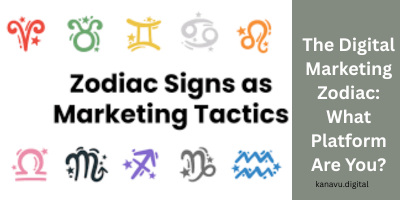
Introduction: Star Signs, But Make It Social Ever wonder which social media platform best matches your brand’s personality?Are you the wise old soul of LinkedIn, the spontaneous sparkle of TikTok, or the aesthetically curated queen of Instagram? Welcome to the Digital Marketing Zodiac — where we ditch the star charts and dive into platform personalities. Because choosing the right platform is not just about where your audience is… it’s also about who you are as a brand. Let’s decode your marketing destiny. ♈ Instagram – The Aesthetic Aries Bold, fast, and dripping in style, brands ruled by Instagram energy are trendsetters. They live in Reels, think in filters, and speak fluent emoji. You’re an Instagram Brand if: Your content is aesthetic-first �� You have a curated vibe You engage through stories and visuals Marketing Mantra: “If it’s not Insta-worthy, did it even happen?” ♉ TikTok – The Playful Gemini Dynamic, dual-faced, and just a little chaotic, TikTok brands are unpredictable in the best way. They adapt fast, ride trends like pros, and aren’t afraid to be goofy. You’re a TikTok Brand if: You thrive on viral content You love short-form storytelling You post fast and often Marketing Mantra: “Engage first. Explain later.” ♊ LinkedIn – The Wise Capricorn Disciplined, polished, and ready with a case study at all times, LinkedIn energy is all about thought leadership and trust. You’re a LinkedIn Brand if: You’re B2B or professional services You post insights, not selfies You believe in value-packed content Marketing Mantra: “Network, nurture, and never not optimize your headline.” ♋ Facebook – The Loyal Taurus Sturdy and nostalgic, Facebook brands are the OGs who love building communities. Despite their lack of ostentation, they have a strong bond with their audience. You’re a Facebook Brand if: You value long-form engagement You run active groups or communities Your audience is slightly older Marketing Mantra: “Community first, conversions second.” ♌ Twitter (X) – The Witty Sagittarius Quick-witted and full of hot takes, Twitter (or X, if you’re into rebrands) brands are conversational stars. You shine through opinions, one-liners, and staying ahead of the trend wave. You’re a Twitter Brand if: You tweet more than you post You love clever comebacks You join trending convos (and start a few) Marketing Mantra: “Why post content when you can post chaos with context?” ♍ Pinterest – The Dreamy Virgo Organized, aspirational, and soothing, Pinterest brands offer value over virality. These are the planners, the creators of dreamy guides, and the curators of aesthetic knowledge. You’re a Pinterest Brand if: Your audience loves DIYs, how-tos, or inspiration You repurpose blog content beautifully You use evergreen pins to play the long game. Marketing Mantra: “Pin it now, traffic forever.” ♎ YouTube – The Visionary Aquarius Innovative, insightful, and always ready for their close-up, YouTube brands go deep. Whether it’s tutorials, vlogs, or educational content—this platform is for the bold and strategic. You’re a YouTube Brand if: You love storytelling and structure You build communities through content You prioritize value + visuals Marketing Mantra: “In a world of scrolls, be a stop-and-stay.” So… What’s Your Marketing Sign? Maybe your brand is a confident Instagram sun with a YouTube rising. Or maybe you’re secretly a Pinterest moon, quietly drawing traffic while everyone else dances for likes. �� Whatever your platform personality, the key isn’t to be everywhere—it’s to be aligned and intentional. When you understand your brand’s energy, you can pick platforms that play to your strengths—not just your fears of missing out. Conclusion: Let the Stars (and Stats) Guide You Your digital destiny doesn’t lie in doing what everyone else is doing.It lies in choosing platforms that match your brand soul, your audience habits, and your content strengths. So next time someone says, “You have to be on TikTok,” smile politely, check your zodiac… and do what works for you.

Reels, Shorts, and Scroll-Stoppers: What to Post Right Now
Why Short-Form Video Still Dominates in 2025 Short-form video isn’t just a trend—it has become the standard. Platforms like TikTok, YouTube Shorts, and Instagram Reels have changed how people consume content. You now have just 3 seconds to grab attention—miss it, and your audience scrolls away. This format continues to outperform static posts and long-form videos in terms of: Reach Engagement Algorithmic priority If your brand isn’t posting short-form content consistently, you’re invisible to a huge chunk of your audience. What the Algorithms Want in 2025 Here’s what the big platforms are rewarding right now: Instagram Reels Favors original audio Use text overlays Consistent posting: 3–5 times/week YouTube Shorts Rewards watch time and replays Hook your viewer early Keep it tight and punchy TikTok Trends still work—but educational and relatable content is winning Value > Dancing Core takeaway: Fast-paced, authentic, and value-driven content wins.Storytelling > High production quality Top 5 Short-Form Video Ideas to Post Right Now “Did You Know?” Hooks Quick, surprising facts that boost engagement and shares. Example:”Did you know 70% of shoppers buy based on UGC videos?” Use bold text overlays and strong visuals. Behind-the-Scenes Snippets Show your process: how things are made, how your team works, or packing orders. Why it works: Builds trust and feels personal. Before & After / Transformation Videos Room makeovers, brand redesigns, quick demos—people love watching progress. Pro tip:Use suspenseful captions like “Wait for it…” or “Watch this change.” Relatable POVs or Memes “If you know, you know” content always works—short skits, day-in-the-life videos, or industry-specific humor. Example:A digital marketer’s campaign launch = chaos + caffeine. Quick Tips or Micro-Tutorials People want fast, useful content. Think: “One simple hack…” or “Three steps to…” Keep it under 30 seconds and use captions. What Makes a Great Scroll-Stopper? Your audience is scrolling fast—here’s how to stop them in their tracks: Bold hooks at the top (“STOP doing this in your ads…”) Unexpected visuals (zoom-ins, camera shake, fast cuts) Relatable voiceovers or trending sounds Use movement—the brain is wired to notice change Add emojis, text animation, and sound effects to guide focus What NOT to Post in 2025 Avoid videos that feel: Over-polished (people scroll past “ad-looking” content) Too generic (no clear niche or audience) Slow to start (no long intros—get to the point!) Authenticity beats perfection. If it looks like it was made on a phone, that’s a plus! Consistency Over Perfection You don’t need to go viral. You need to show up. Simple short-form strategy: Post 3 Reels/Shorts per week Rotate content: Education, Entertainment, Behind-the-scenes Use trending sounds only when relevant Final Thoughts Short-form video is still your best chance to grow in 2025.It doesn’t have to be perfect. It just has to be: Quick Valuable Real 👉 So next time you wonder what to post:Keep it short. Make it scroll-stopping. Post it now

Marketing for Startups with ₹0 Budget: Hustle vs Hype
Starting up? No money? No problem. If you’re a founder with big dreams but an empty wallet, you’re not alone. Many startups begin with passion, not capital. The key? Knowing how to market smart when the budget is zero. This is where the difference between hustle and hype matters. Real hustle builds lasting value. Hype might get attention, but it rarely converts. Here’s how to grow your brand the right way—with grit, not gimmicks. What Does Marketing with ₹0 Budget Really Mean? Marketing with no budget doesn’t mean no effort. It means maximizing time, creativity, and consistency instead of money. It’s about making every move count—from how you tell your story to where you show up online. It’s about being resourceful, not reckless. Hustle: The Real Work That Drives Growth 1. Content is Your Currency Start a blog. Publish on Medium. Share posts on LinkedIn. Create threads on X (formerly Twitter). Use Instagram Reels. The trick is consistency and relevance. Don’t overthink. Focus on solving your target audience’s problems or answering their burning questions. Tips: Use free tools like Grammarly, Hemingway, and ChatGPT to polish your content. Repurpose content across platforms. One blog post = five LinkedIn posts + one Instagram carousel + a Twitter thread. 2. Personal Branding = Business Branding As a founder, you’re your startup’s first ambassador. Build in public. Share your learnings, failures, and wins. Be real, not polished. People follow people, not logos. How to start: Post 3-4 times a week on LinkedIn. Comment on posts by founders and potential customers. Join startup and industry groups. 3. Community is Your Shortcut Find or create communities where your audience hangs out. Engage before you promote. Offer value. Become a known name. Where to look: Reddit, Discord, Slack groups, Telegram, WhatsApp communities LinkedIn groups, Twitter Spaces, niche Facebook groups 4. Collaborate Over Compete Partner with other early-stage founders. Do co-webinars, shout-outs, content swaps, or joint giveaways. It expands reach without spending money. Example: You have a startup selling healthy snacks. Team up with a fitness app to run a joint campaign. Hype: The Pitfalls That Derail Real Progress 1. Obsessing Over Vanity Metrics It’s easy to chase likes, views, and followers. But these don’t always mean traction. Focus on numbers that matter: email signups, demo requests, conversions, retention. Warning signs: Buying followers Prioritizing aesthetics over authenticity 2. Pretending to Be Bigger Than You Are Exaggerated claims or overly polished branding can hurt you. People value transparency. They’re more likely to support scrappy underdogs than faceless corporations. Tip: Be honest about where you are in the journey. It’s relatable and builds trust. 3. Wasting Time on Flashy, Low-Return Tactics Trendy tactics like viral challenges or influencer shout outs may offer a spike but not sustainable growth—especially when forced. Stick to what aligns with your brand and speaks to your target user. Free (and Powerful) Tools for Zero-Budget Marketing Here are some tools every bootstrapped startup should have in their kit: Canva: For designing pitch decks, posts, and presentations Buffer / Hootsuite (free plans): For scheduling social media content ChatGPT: For writing help, brainstorming ideas, and creating headlines Notion: For managing content calendars Google Trends: To know what people are searching Ubersuggest: For keyword research Final Thoughts: Hustle Wins, Hype Fades Zero-budget marketing is not about doing everything. It’s about doing the right things consistently. Forget the hype. Build a foundation. Talk to your customers. Show up online. Add value. Be human. The hustle may be slower, but it leads to trust, traction, and long-term growth. Want visibility? Earn it. Want credibility? Build it. Want growth? Hustle smart.