
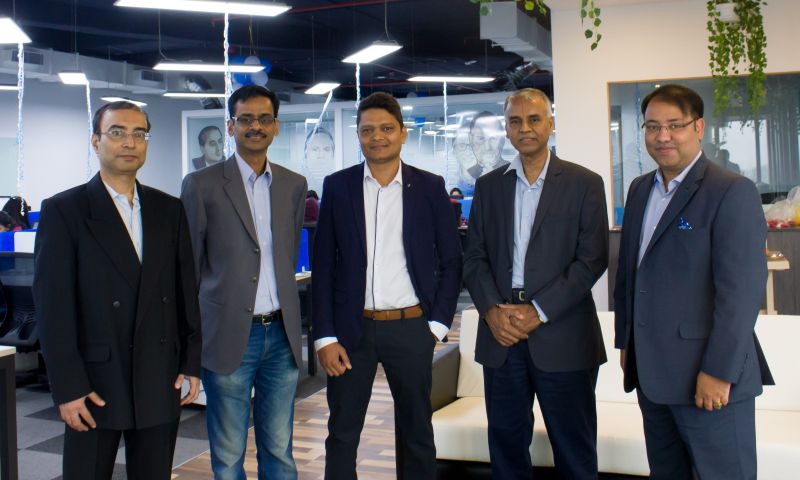
Perfios has successfully raised $229 million at a valuation of $900 million, further expanding its presence in North America and Europe. V.R. Govindarajan, the founder, had a journey that began with working at IBM and DEC before returning to India to establish Aztec software in 1996. Aztec, a company built in India for global markets, went public in 2000 and was later acquired by MindTree in 2008. After this acquisition, Govindarajan, along with his Aztec colleague Chakraborty, envisioned a tool that could offer a unified financial dashboard. Their goal was to empower retail individuals to automate the consolidation and management of their portfolios and debt. Thus, the first version of Personal Finance One Stop (Perfios) was created. However, monetizing the tool proved challenging, given India’s limited internet user base of 93 million in 2008, and consumers were reluctant to pay for a personal finance management solution. Initially targeting CAs and wealth managers did not yield the desired results. To pivot, Perfios shifted its focus to the B2B market, enhancing its product with an analysis layer and presenting it to banks. By 2016, it had secured over 50 enterprise customers, leading to a successful Series A funding round in 2017. As of now, Perfios boasts 300 customers, positioning itself as a soonicorn, and concluded the fiscal year 2022 with a revenue of ₹136 crore. The company anticipates doubling its revenue projections for the fiscal year 2023, aiming for ₹270 crore.
Google Cloud turns profitable after 15 years
Google Cloud, after 15 years of losses, is making strides towards its first profitable year. In contrast, Amazon Web Services (AWS), with 34% market share, has been a significant profit driver for Amazon, generating $23 billion in annual profits. Google’s cloud struggles stem from its emphasis on consumer-facing tech products, which differ significantly from the enterprise market. Despite launching after Microsoft’s Azure, Google fell behind in the cloud race due to its focus on simplicity rather than functionality and customer-centricity. The company experienced significant growth, but its costs soared, including expenses related to hiring and data centers. Attempts to compensate for organic shortcomings through acquisitions, such as the $550 million Firebase deal, did not immediately improve its cloud profitability. A turning point occurred with the hiring of Thomas Kurian, a cloud veteran from Oracle. Under new leadership, Google Cloud recognized that AWS and Azure were creating closed ecosystems, presenting an opportunity for Google to differentiate itself. Rather than directly engaging with clients, Google Cloud sought to win over channel partners who were being undercut by competitors. By championing open-source initiatives and attracting third-party developers, Google Cloud diversified its offerings and compensated for its lack of enterprise acumen. The company reduced marketplace commission charges for partner firms and adopted a co-selling approach. This strategy attracted over 35,000 entities to its Partner Advantage Program, with most enterprise wins now occurring through co-selling with partners like Accenture, Deloitte, and Tata Consultancy Services. As a result, Google Cloud posted profits of $395 million in the latest quarter, contributing to over 10% of Alphabet Inc.’s revenues. While the company has made progress, it holds a 10% market share, making it the third-largest cloud provider behind Azure and AWS. The question remains whether Google Cloud can close this gap and compete more closely with its rivals.

The Inshorts ad revenue design to $100 million
In 1994, AT&T placed the world’s first online banner ad in Hotwired magazine, marking the beginning of digital advertising. Fast forward to today, where the digital advertising market is projected to reach $19.2 billion by 2026. In this landscape, Indian startup Inshorts has made a notable impact, potentially disrupting the industry for Indian advertisers. Inshorts’ Journey: Early Years (2013-2015): Inshorts started as a Facebook page in 2013, providing news in a concise 60-word format. It quickly gained popularity, leading to the launch of a dedicated app that garnered one million downloads in six months.User-Centric Approach: Despite its popularity, Inshorts refrained from running ads on its platform for the first three years. The focus was on building for users rather than advertisers, with personalized news delivery in a fact-based 60-word format.Entry into Advertising (2016): Inshorts entered the advertising space in 2016 with its first ad featuring Airtel. By 2018, the platform had partnered with over 100 clients, including prominent brands like Netflix, Maruti Suzuki, MRF, and Audi.Maintaining Principles: Inshorts maintained its principles throughout its advertising journey. The emphasis remained on active and engaged users, with metrics such as shorts read per day considered crucial. The platform remained transparent with advertisers, avoiding false promises and offering clear demarcation for brand awareness and engagement.Innovation in Ad Formats: Inshorts focused on innovation in ad formats, moving beyond traditional display ads. The platform introduced more than six ad formats, experimenting with native, engaging, and personalized solutions for different industries.Revenue Growth: By following its principles, Inshorts achieved significant revenue growth, reaching $10 million in ARR from ads in 2019, with projections indicating it could surpass $30 million ARR by 2022. Survival and Evolution: User-First Approach: Inshorts prioritizes user experience, avoiding excessive ads that could compromise user satisfaction. The platform’s zero-tolerance for poor user experience includes options for personalized feeds and relevant content.Ad Formats and Placement: Inshorts’ ad formats seamlessly blend with the content, ensuring engagement. Popular ad formats include 60-word native ads, fact cards for engagement and awareness, magazine cards for extended engagement, and interstitial ads for awareness.Industry-Specific Customization: Inshorts tailors its advertising offerings for industry-specific use cases. For example, it created a live market replica for crypto trading platforms, demonstrating an innovative approach.Localization and Targeting: The platform is working on providing multiple language options to expand its reach. Inshorts acquired Retention.ai in 2017 to understand user patterns and behavior better, enabling effective targeting for advertisers.Clear Communication with Advertisers: Maintaining transparent communication with advertisers is crucial for Inshorts. The platform provides creative layouts and ideas, setting clear expectations from day one. Future Strategies: Innovation in Ad Formats: Inshorts plans to continue its focus on ad format innovation, improving click-through rates (CTR), introducing graphical and infographic representation ad formats, and optimizing the number of ads per user.Geographical Expansion: The platform aims to expand to more geographies, offering content in multiple languages to tap into diverse markets.Diversification of Clients: Inshorts plans to diversify its portfolio of clients beyond those focused on awareness, exploring formats or placements that lead to conversions at scale. This could open avenues for smaller brands and recurring revenue. Inshorts’ success hinges on maintaining a balance between user experience and revenue generation, and its strategic approach to advertising has positioned it as a key player in the Indian digital advertising landscape.
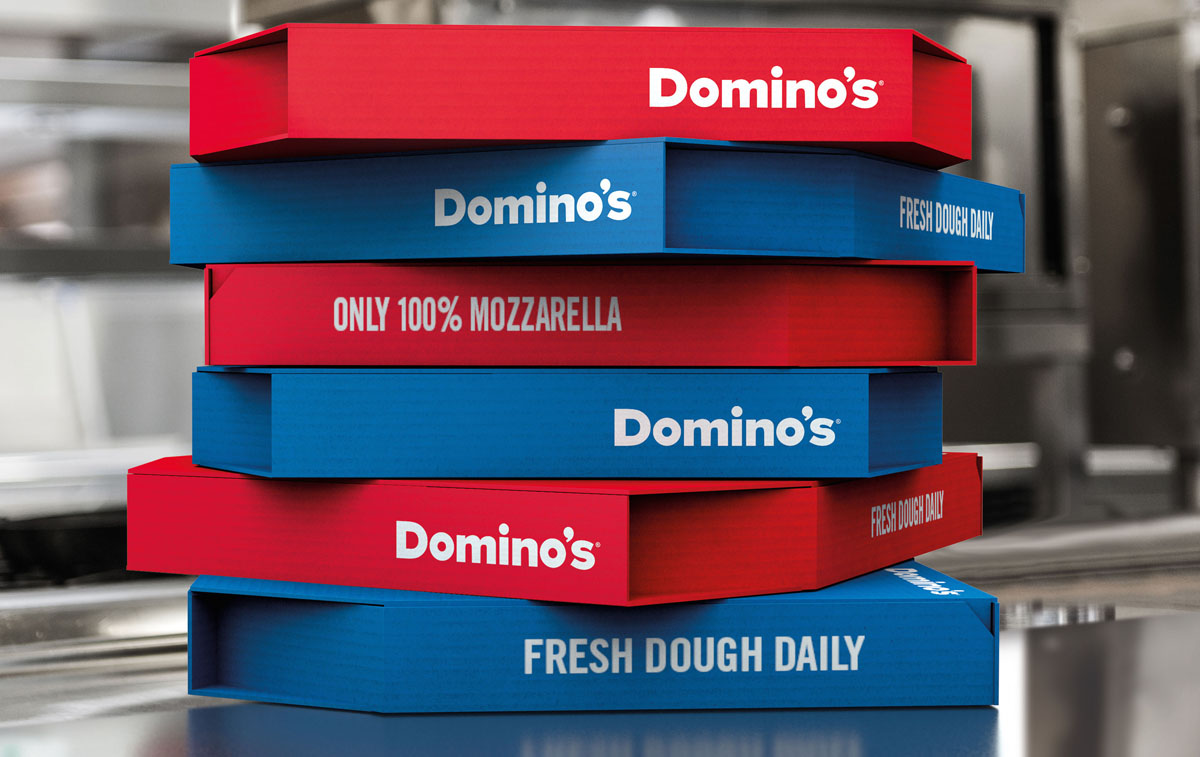
Can Domino’s survive Zomato & Swiggy?
Domino’s strategic move to launch its loyalty program, “Cheesy Rewards,” in July 2022 appears to be a successful initiative in regaining control over customer relationships and reducing dependency on food aggregators like Zomato and Swiggy. The program, offering a free pizza after every 6th order but exclusively for orders placed through Domino’s own platform, has shown impressive results: 10 million quarterly app downloads16.8 million loyalty members10.3 million monthly active users48% of sales from loyalty membersHigher order frequency This initiative has not only helped Domino’s tap into a significant untapped potential by realizing that a majority of its revenues come from a small fraction of customers but has also allowed the company to retain its brand identity and control over customer relationships. However, sustaining a delivery-led business model in the long run poses challenges. Here are some factors to consider: Market Dynamics: Zomato and Swiggy, driven by aggressive discounting and growth-focused strategies, may continue to exert pressure on Domino’s. Market dynamics and customer preferences can evolve, impacting Domino’s ability to compete effectively.Dependency on Aggregators: Despite the success of the loyalty program, Domino’s still relies on Zomato and Swiggy for almost 25% of its sales. Any significant shift in market power may influence the dynamics of commission rates and terms, affecting Domino’s profitability.Operational Challenges: Managing its own delivery force comes with operational challenges and costs. Retaining delivery personnel amid the gig economy’s fluctuations and increasing salary expectations can impact Domino’s cost structure.Changing Consumer Behavior: Consumer behavior is dynamic, and preferences for ordering through aggregators versus individual platforms can shift. The convenience offered by aggregators and their extensive reach may influence consumer choices.Competition and Innovation: The food delivery segment is highly competitive, and innovation plays a crucial role. Domino’s needs to continually innovate, both in terms of its menu offerings and customer engagement, to stay ahead and provide a compelling reason for customers to order directly. While the loyalty program has shown early success, sustaining a delivery-led business model requires a nuanced approach that considers evolving market dynamics, competition, and changing consumer behaviors. Domino’s needs to adapt to these challenges, possibly by leveraging technology, refining its loyalty program, and maintaining a balance between aggregator partnerships and its own platform.
Whatsapp’s bet on Razorpay
WhatsApp and Razorpay have made a significant announcement, signaling a deep integration that is poised to transform mobile commerce in India. With 500 million users, India stands as WhatsApp’s largest market globally, and this move is seen as a strategic shift from being a mere chat app to positioning itself as a major player in mobile commerce. Breaking down WhatsApp’s role into four categories: Group Communication: Recent features like “channels,” “screen sharing,” and “broadcast” functionalities are aimed at addressing various communication needs for users within groups.Business-to-Consumer Communication: WhatsApp is actively working towards replacing SMS and becoming the preferred channel for brands to communicate with their customers. The recent focus on “channels” and “business accounts” supports this objective.Logistics (Full Stack Approach): The partnership with JioMart is designed to enhance the end-to-end consumer delivery experience. This collaboration allows WhatsApp to scale its services across numerous PIN codes without having to build its own logistics infrastructure.Payments: WhatsApp holds a 0.1% share of the UPI market in India. However, the growth of WhatsApp Pay has been restricted by regulatory limitations on the number of customers it can onboard. The partnership with Razorpay, India’s largest payment gateway with an RBI Payment Aggregator license, addresses these challenges and unlocks new possibilities. Significance of the WhatsApp-Razorpay Integration: Native Shopping: This collaboration facilitates “native shopping” experiences. D2C brands, such as Tira Beauty, can sell products directly to customers through WhatsApp without requiring them to visit external websites. This streamlined process is particularly impactful for repeat purchases.Entry Point for Businesses: WhatsApp becomes the primary entry point for businesses to showcase and sell their products. Users can make purchases without navigating to external websites or using search engines, simplifying the buying process and making it more accessible.Catering to New Online Shoppers: With a significant portion of Indians yet to make their first online purchase, WhatsApp’s integration with Razorpay is expected to be a game-changer. The collaboration may serve as a catalyst for a large number of users to make their initial online transactions through the familiar WhatsApp platform. In essence, this move positions WhatsApp in direct competition with established e-commerce players like Meesho, Amazon, and Flipkart, as it aims to capture a substantial share of the evolving mobile commerce landscape in India.
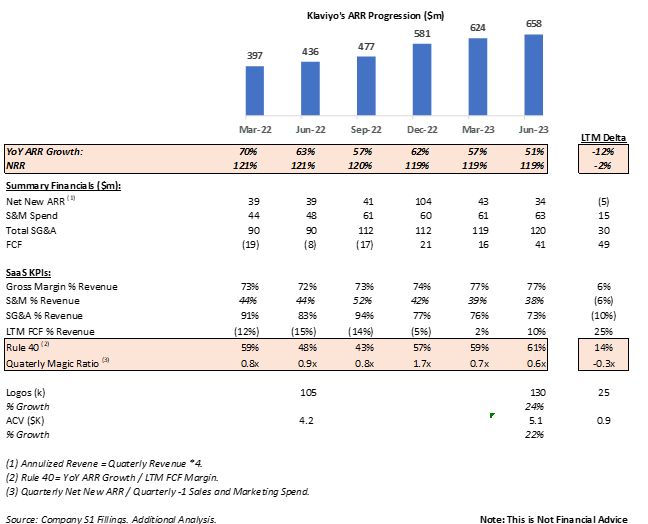
The story of Klaviyo’s success
$15 million in funding has been utilized to generate an impressive $658 million in Annual Recurring Revenue (ARR)! 🚀 Klaviyo, which recently declared its intent to go public, has revealed remarkable Software as a Service (SaaS) Key Performance Indicators (KPIs). The company is experiencing a 50% annual growth rate and achieving a commendable 60 on the Rule of 40! Klaviyo’s growth and efficiency figures are exceptionally impressive, but the question lingers: are they sustainable? Klaviyo, specializing in Small and Medium Enterprise (SME) marketing automation (email, SMS, and push notifications) within the Shopify ecosystem, boasts an Annual Contract Value (ACV) of approximately $5,000. Its primary go-to-market strategy involves a Product-Led Growth (PLG) approach with land and expand motions. 𝗕𝗿𝗲𝗮𝗸𝗶𝗻𝗴 𝗗𝗼𝘄𝗻 𝗚𝗿𝗼𝘄𝘁𝗵: – The September 22 price increases significantly contributed to growth, evident in the Net New ARR spike of $104 million in December 22. – The impact of these price increases on ARR was immediate, as Klaviyo’s customers predominantly operate on monthly contracts. To gauge the effect of these price increases, clues lie in the filings: – The S1 document states that price increases constituted a “mid-teens” percentage of incremental revenue over the Last Twelve Months (LTM), equating to $33 million of the total LTM Net New ARR ($222 million). – This implies a contribution of +8% to the Year-over-Year (YoY) growth of the company ($33 million / $436 million June 22 ARR). – When normalizing this impact, considering one-off nature of price increases, the YoY growth falls to 43%. Additionally, the customer base grew by only 24%. 𝗪𝗵𝗮𝘁 𝗱𝗼𝗲𝘀 𝘁𝗵𝗶𝘀 𝗺𝗲𝗮𝗻 𝗳𝗼𝗿 𝘁𝗵𝗲 𝗴𝗿𝗼𝘄𝘁𝗵? ➡️ Considering that price rises are typically one-off, and sustaining such high levels of ACV growth may be challenging, the prediction is that growth will trend towards the 35-40% range in the coming 12 months. (Management has not provided guidance, so the accuracy of this prediction remains uncertain until the roadshow!) 𝗛𝗼𝘄 𝗮𝗯𝗼𝘂𝘁 𝗽𝗿𝗼𝗳𝗶𝘁𝗮𝗯𝗶𝗹𝗶𝘁𝘆? Cash flow margins have remained robust over the last two quarters, reaching a Last Twelve Months (LTM) margin of 10%. This is driven by a consistent Sales and Marketing (S&M) spend over the last four quarters and an improving gross margin (due to higher overall ACVs). However, achieving 40% growth next year would necessitate adding around $263 million in net new ARR, likely requiring an investment in S&M spend, considering the declining magic ratio observed in the last two quarters. ➡️ Nevertheless, given the minimal cash consumption since inception, Free Cash Flow (FCF) margins are estimated to be maintained in the 0-10% range. 𝗡𝗼𝘁𝗶𝗻𝗴 𝗮𝗹𝗹 𝘁𝗵𝗲 𝗮𝗯𝗼𝘃𝗲, 𝘄𝗵𝗲𝗿𝗲 𝗱𝗼 𝗜 𝘁𝗵𝗶𝗻𝗸 𝘁𝗵𝗲 𝗰𝗼𝗺𝗽𝗮𝗻𝘆 𝘄𝗶𝗹𝗹 𝗯𝗲 𝘃𝗮𝗹𝘂𝗲𝗱? Given the substantial Total Addressable Market (TAM) and top-tier metrics, it’s challenging to envision this not being priced at the upper end of SaaS company valuations (10-13x ARR).

Revolutionizing Compensation Practices in Indian Corporations
Companies are reconsidering their compensation structures and benefits packages in an effort to retain top-performing employees. While attrition rates have stabilized across India Inc, organizations are reassessing variable pay, introducing more long-term incentives, and providing skilling initiatives to manage costs. Yokohama Rubber Co., a Japanese tire manufacturer, has discontinued variable pay at entry levels, and companies in various sectors are revising the criteria for organizational success in the variable pay of younger employees. Startups, on the other hand, are opting for more stock options and other long-term incentives rather than cash bonuses. Amidst rising wage costs as a percentage of revenue for IT giants like TCS, Wipro, and HCLTech in the first quarter of FY24, salary hikes have been moderated, and variable payouts have been reduced. However, there is a heightened emphasis on learning and skilling programs in AI/ML to address attrition. Promotion cycles are increasingly tied to the growth of high-performing employees rather than their tenure of service. Nevertheless, attrition remains a challenge at the junior levels.
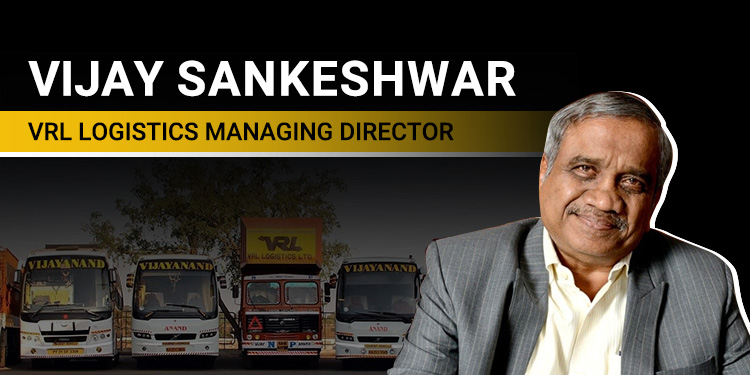
The Uncharted Journey of Vijay Sankeshwar
Vijay Sankeshwar, a visionary leader hailing from Dharwad, Karnataka, is the proud owner of India’s largest fleet of commercial vehicles. As the Managing Director of VRL Group, he oversees a fleet of over 5000 trucks. Sankeshwar’s keen business acumen has not only led to the establishment of successful enterprises but has also left a significant impact on society. Throughout his illustrious career, Vijay Sankeshwar has remained dedicated to values such as hard work, innovation, and compassion. **Vijay Sankeshwar: Interesting Facts** – Fondly known as the ‘Trucking King of India.’ – In 2022, his son Anand Sankeshwar announced the production of a biographical film titled “Vijayanand,” chronicling his father’s extraordinary journey. – Commenced his business journey at the age of 16. – Upgraded his printing press with modern machinery at the age of 19. **Vijay Sankeshwar: Education and Childhood** – Born on August 2, 1950, in Betagiri, a small town in Mysore, Karnataka, India. – Hails from a humble family with an agricultural background. – Despite facing childhood challenges, Sankeshwar exhibited a resilient spirit and profound entrepreneurial mindset. **Journey as an Entrepreneur** >”All of my ventures were completely and undoubtedly based on the trial and error method. We have never copied anyone in our business models, ever.” —- Vijay Sankeshwar Vijay Sankeshwar initiated his entrepreneurial journey in 1966 when his father presented him with his first printing press, Vijay Printing Press. Starting with modest equipment and two employees, he expanded the printing enterprise in 1969 with modern machinery. Simultaneously, he ventured into the transportation industry with a single truck acquired through a Rs. 2 lakh loan. Sankeshwar’s emphasis on customer satisfaction, efficiency, and reliability positioned VRL Group as one of India’s largest logistics and transport companies, boasting a vast fleet of trucks, buses, and cargo carriers. **Diversification and Expansion of VRL Group** Driven by a passion for growth and diversification, Sankeshwar expanded VRL Group into various sectors. The company now spans road transportation, parcel services, courier services, hospitality, and media Vijayavani has gained widespread popularity and played a significant role in shaping public opinion in Karnataka. **Philanthropy and Social Contributions** – Actively involved in various charitable initiatives. – Through the VRL Foundation, the CSR arm of VRL Group, contributed to educational institutions, healthcare facilities, and community development programs. **Vijay Sankeshwar: Association with Politics** – Initiated his political involvement during his early years, actively participating in meetings organized by the Rashtriya Swayamsevak Sangh (RSS). – In 1996, ventured into politics, winning the 11th Lok Sabha elections from the Dharwad constituency as a Bharatiya Janata Party (BJP) member. – From 1999 to 2000, served on various parliamentary committees, including Transport and Tourism. – In 2003, founded the Kannada Naadu Party (KNDP) after a conflict with the BJP but reconciled with the party in 2014 when the Karnataka Janata Paksha (KJP) merged with the BJP. **Vijay Sankeshwar: Awards and Achievements** – Udyog Ratna Award by the Institute of Economic Studies in 1994. – “Transport Personality of the Year” at the India Road Transportation Awards (IRTA) in 2012. – Awarded the Padma Shri in 2020, India’s fourth-highest civilian award, by President Ram Nath Kovind. Vijay Sankeshwar’s net worth stands at $8 million (as of 2022), serving as an inspiration for entrepreneurs, emphasizing that success can be achieved through hard work and a commitment to making a positive impact on society.
The evolution of GreyOrange
India’s GreyOrange, often overlooked in the realm of deep-tech innovation, has emerged as a dark horse in the $10 billion e-commerce robots industry, surpassing expectations as a global leader. Co-founders Akash Gupta and Samay Kohli, who initially met at BITS Pilani in 2007, embarked on a challenging journey to create something extraordinary. In 2011, with an investment of 5 lakhs, Gupta and Kohli established GreyOrange, defying the assumption that India was an unlikely hub for deep-tech innovation. Focused on robotics, their journey began with the creation of Acyut, India’s first humanoid, earning them gold at the World’s Robo Olympics. Despite the absence of a conducive startup or hardware ecosystem, they persisted. A turning point came in 2012 when a visit to Flipkart’s warehouse inspired them. The complex warehousing problem required an elegant solution, and with the support of German technologist Wolfgang Hoeltgen, who moved to India to mentor them, GreyOrange secured its first order from Flipkart. The development of the Butler Robot system revolutionized warehouse operations, with Flipkart reporting a 4x increase in item picking and an 80% drop in shipment time. GreyOrange’s potential became evident, leading to a significant fundraising round. By 2016, challenges like one-day deliveries and labor shortages became prominent, mirroring global trends seen in Amazon’s acquisition of Kiva. India’s GST ruling further propelled GreyOrange’s growth as it moved towards central warehousing. The company’s trajectory continued to impress, with Home Logistics in Japan selecting GreyOrange in 2017, and a staggering 300% growth by 2018. The company raised an impressive $140 million, reaching $100 million in revenue by 2019, a noteworthy achievement for a deep-tech Indian company. The COVID-19 pandemic in 2020 transformed robots from a luxury to a necessity, propelling e-commerce and diminishing labor availability. GreyOrange responded swiftly, raising $110 million in 2022, valuing the company at $600 million. Despite a challenging year that delayed IPO plans and prompted a management reorganization, GreyOrange started 2023 strongly with $150 million in revenue. The company has solidified its position as a global leader in mobile autonomous robots, expanding its team to 1,000 people worldwide and hiring regional CEOs. GreyOrange’s journey exemplifies how a robotic ambition from India can evolve into a globally recognized company over a decade.

Transforming the Landscape of Luxury Retail with Technological Innovations
Luxury retailers worldwide are currently favoring technology investments, focusing on areas such as customer experience, digital payments, and enhancing sales and visibility, according to Romita Majumdar’s report for The Economic Times. Ravi Kapoor, Partner and Leader of Retail and Consumer at PwC India, notes that about 55% of these investments are directed towards online platforms, driven by the surge in e-commerce due to the pandemic. Key areas of expenditure include payment technologies, social commerce, resale, supply chain and logistics, as well as NFTs and virtual reality. Mohan Krishnan, Global Head of Retail Strategic Initiatives at Tata Consultancy Services, highlights the interest of retailers in advanced technologies like 3D, XR (extended reality), and generative capabilities for product development and customer experience. Indian tech and IT giants, such as Cognizant and Accenture, play a crucial role in driving this transformation by assisting luxury retailers in reimagining digital commerce platforms and adopting a technology-led approach to enhance sales. Ganesh Kalyanaraman, SVP and Delivery Head – Global Growth Markets at Cognizant, emphasizes the contribution of Indian talent in improving customer experience and store operations for global luxury retailers. This is achieved through analytics-driven personalization, multiverse fusion, intelligent inventory tracking, and omnichannel enablement. As brands recognize the significance of investing in new technologies, it is anticipated that spending on these innovations will increase, reaching up to 3-4% of sales by 2030, according to Kapoor. Retail companies are significantly investing in tracking demand trends and consumer behavior for communication purposes and strategic supply chain planning, as mentioned by Anand Ramanathan, Partner and Consumer Industry Leader, Consulting at Deloitte India.