When you log in to an application, place an order or check a payment status, something happens behind the screen. A backend processes your request, communicates with databases and returns the result.
But as applications grow, managing thousands of lines of backend code becomes challenging.
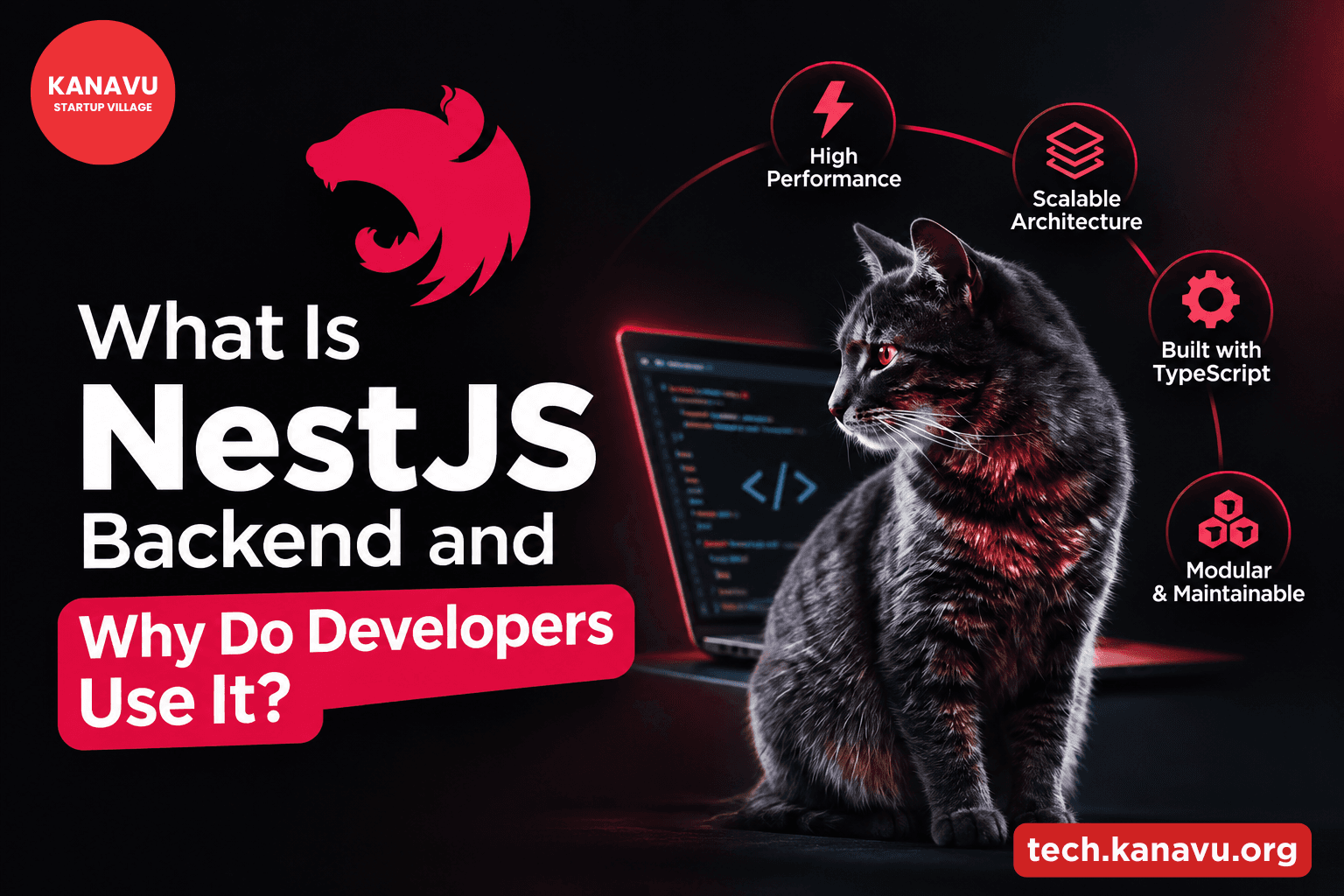
NestJS Backend helps developers organise this complexity. It provides a structured framework for building server-side applications using Node.js and TypeScript.
What Is NestJS Backend and How Does It Work?
NestJS is a Node.js framework commonly used to build APIs, web applications and backend services. It is one of the modern web development technologies helping developers build structured and scalable applications.

It works with HTTP server platforms such as Express and Fastify, while providing an organised development structure.
The NestJS Framework Architecture has three important building blocks:
| Component | Responsibility |
|---|---|
| Controllers | Receive incoming requests |
| Services | Handle application logic |
| Modules | Organise related functionality |
For example, when a customer places an order, a controller receives the request, a service processes it, and a database stores the information.
This separation makes the application easier to maintain.
Why Do Developers Choose NestJS Backend?
1. Organised Code with Modules
NestJS divides applications into reusable modules.
A shopping application can have separate user, product, order and payment modules, allowing developers to update features without mixing unrelated code.
2. TypeScript Support
NestJS uses TypeScript, which helps developers identify many type-related mistakes during development.
This improves code readability and makes collaboration easier.
3. Dependency Injection
NestJS includes Dependency Injection, allowing services to receive required dependencies instead of creating them directly.
This reduces unnecessary coupling and simplifies testing.
4. API Security and Validation
Built-in concepts such as guards, pipes and exception filters help developers implement access control, validate incoming data and handle errors consistently.
Security still depends on proper implementation.
5. Microservices and Database Integration
NestJS supports microservice communication through transports such as Redis, Kafka and gRPC.
It also integrates with databases, including MySQL, PostgreSQL and MongoDB, through suitable drivers and libraries.
When Should You Use NestJS?
NestJS is particularly useful when developing:
- Business applications with multiple connected modules.
- REST APIs for websites and mobile applications.
- ERP systems with complex business processes.
- Microservices requiring organised communication between services.
For smaller applications, simpler frameworks may also be suitable.
Businesses developing complex applications, ERP systems and connected platforms can also explore custom software development solutions designed around their operational requirements.
Build Reliable Applications with Kanavu Technologies
A well-structured backend helps applications remain easier to maintain as business requirements change.
At Kanavu Technologies, we develop websites, mobile applications and ERP solutions using technologies suited to each project.
Our development approach focuses on practical architecture, reliable functionality and long-term maintainability.
External Source: For a detailed overview of its features, modular architecture and capabilities, visit the official NestJS website.